
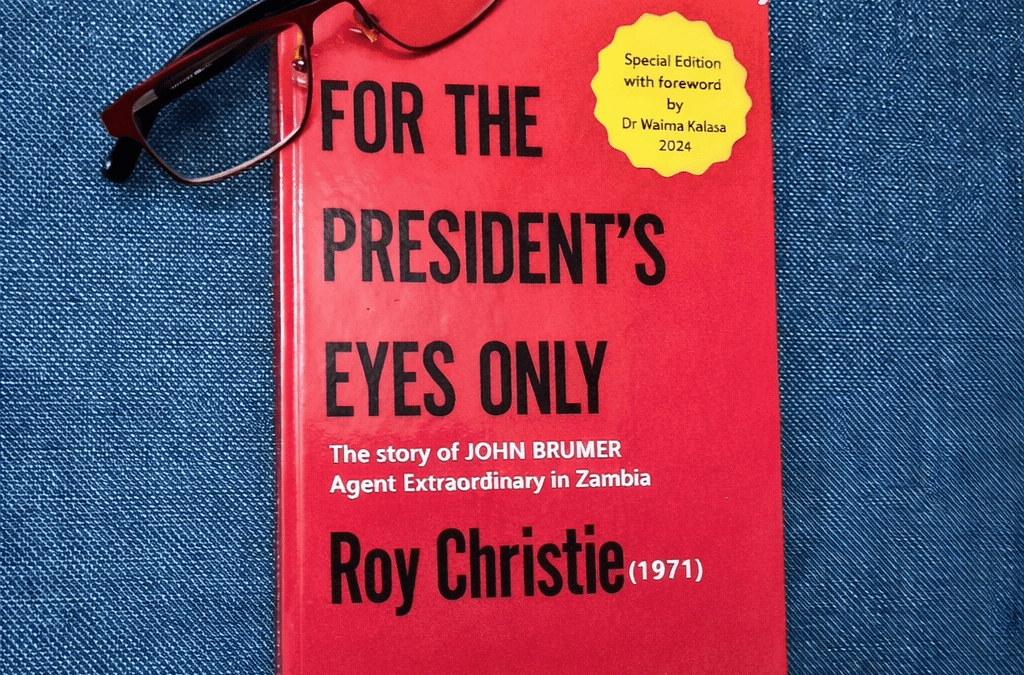
When tributes are given at a person’s funeral, a glimpse into their life is shared, though incomplete. There are several dynamics to be factored in based on the relationship the narrator had with the individual. For a man like Dr Kenneth Kaunda, Zambia’s first president, there is a great deal of material available about his life, from academic, political, economic, and social perspectives. However, no one had told the story from the lens of a double agent until Roy Christie did.
In literary circles, there is a running wish among writers to either get arrested or have their book banned. A small sacrifice to pay for the rewards such an event would have on book sales. It was intriguing to learn that in Zambia, a book titled, For the President’s Eyes Only by Roy Christie was banned. It joined a list of other foreign books forbidden from the bookshelves, like The Perfumed Garden by Umar ibn Muḥammad Nafzāwī, Lady Chatterley’s Lover by D.H. Lawrence, and The Satanic Verses by Salman Rushdie.
The reprint of the 1971 book is under the banner of the ‘History: Echoes of the Past, Whispers of the Future’ project and carries a foreword by historian Dr Walima Kalusa. For the President’s Eyes Only is the extraordinary biography of John Brumer, a Polish man who came to Rhodesia seeking adventure, loathed communism, and ended up on a first-name basis with the Zambian president. Roy describes Brumer as someone with a natural flair for dealing with people from all walks of life, and his instinctive charm, good manners, and organisational ability made him a natural asset to the profession as a Southern Rhodesian spy.
Brumer initially proved himself a worthy asset to the Rhodesian government after gaining the trust of high-ranking officials in ZANU and used his position to sabotage their efforts for independence. With Rhodesia’s Unilateral Declaration of Independence looming and the African continent under communist assault, the Rhodesian Special Branch gave Brumer his next target — President Kenneth Kaunda.
Like a character plucked out of a Jeffrey Archer novel, John skillfully weaved himself into the corridors of State House, and an exchange of presumed ‘secret’ information blossomed into a friendship. Brumer would occasionally spend nights in the Blue Room and divide his time between Lusaka, Luanshya, and Salisbury. Throughout the book, the reader gathers that President Kaunda is a man held in high regard. “Kenneth Kaunda was, and still is, a hard-working and conscientious man who does not tolerate fools or favour-seekers gladly. He seldom grants any one person more than 10 minutes of time, and his work day often extends from 7 am – midnight,” writes Christie. Therefore, it is even more baffling that he fell under the spell of John Brumer.
It also raises questions about President Kaunda’s judgment and why he trusted John easily. In certain sections of the book, it is elaborated that KK was suspicious and distrustful of the people around him. For instance, KK instructed Brumer, “… I also want you to weed out all the unreliable elements from my personal staff and civil service in general. Then of course, you’ll have to organise a really efficient Intelligence Service in Zambia.” This was also during a period when countries were gaining independence, and others were experiencing coups, so the threats were plausible.
In the late 60s, Zambia still lacked the technical capacity and skilled workforce to run some of its operations. It raises questions about the gaps left by colonialism’s end and about the nation’s vulnerability. All this presented fertile ground for a man like Brumer to step in and reap. However, it was the hubris John had coupled with British intelligence that would bring everything crashing down spectacularly.
Roy Christie was a veteran South African journalist and editor who spent hours with John Brumer and made many recordings. The pictorial evidence in the book provides credence to the work. Nonetheless, the author admits he took creative licence in describing some events and dialogue to move the story along. This can bring into question how factual some of the events were. As the book was banned, there is limited literature on John Brumer, unlike other trusted advisors, such as the spiritual leader Raganathan, who is mentioned in books published by people close to Kaunda. It is either that Brumer covered his tracks well as a spy, or people did not have enough information about his influence on KK.
It is human nature to bury and forget our embarrassing moments. There is added motivation if those incidents can serve as ammunition for our enemies, involve betrayal, and expose our frailties. Did For the President’s Eyes Only deserve to be banned? It is a conclusion for the reader to decide. John Brumer was part of KK’s story, and it may have been a bleep, a comma, or a colon in his long life. It is still part of his story. We would be failing as a nation if the only history we knew were sanitised and glossy versions of events. It is important to embrace all its parts, especially as generations pass and all we are left with is second-hand information. Silencing voices with differing experiences and narratives of this period does an injustice to future generations. If we allow our unfiltered history, Zambia’s history, to be told, we will become richer for it.
For the President’s Eyes Only (1971) by Roy Christie (2025 reprint)
To purchase a copy, contact: 0961842218
Recent Comments